Akira Suzuki (chemist) Contents Early life and education Career Invention without patent Recognition See...
Kenichi FukuiHideki ShirakawaRyōji NoyoriKoichi TanakaOsamu ShimomuraEi-ichi NegishiAkira SuzukiEisaku SatōSusumu TonegawaShinya YamanakaSatoshi ŌmuraYoshinori OhsumiTasuku Honjo
Japanese chemistsJapanese Nobel laureates1930 birthsLiving peoplePeople from HokkaidoNobel laureates in ChemistryRecipients of the Order of CultureHokkaido University alumniHokkaido University faculty20th-century chemists21st-century chemists
Nobel Prize LaureateSuzuki reactionorganic reactionarylvinylboronic acidhalidepalladium(0)complexMukawa, HokkaidōHokkaido UniversityPhDmathematicsarithmeticorganic synthesisLouis FieserHarvard UniversityHerbert C. BrownPurdue UniversityHerbert C. BrownPurdue Universitycoupling reactionNorio MiyauraSuzuki reactionboronic acidsarylvinyl groupOkayama University of ScienceKurashiki University of Science and the ArtsAcademic SinicaNational Taiwan UniversityNobel Prize for ChemistryRichard F. HeckEi-ichi NegishiSuzuki reaction
Akira Suzuki (chemist)
Jump to navigation
Jump to search
Akira Suzuki | |
|---|---|
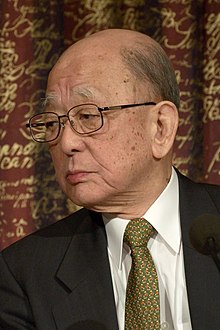 Suzuki in 2010 | |
| Born | (1930-09-12) September 12, 1930 Mukawa, Hokkaidō, Japan |
| Nationality | Japan |
| Alma mater | Hokkaidō University |
| Known for | Suzuki reaction |
| Awards | Nobel Prize for Chemistry (2010) Person of Cultural Merit (2010) Order of Culture (2010) |
| Scientific career | |
| Fields | Chemistry |
| Institutions | Hokkaidō University Purdue University University of Wales Okayama University of Science Kurashiki University of Science and the Arts |
| Influences | Herbert Charles Brown |
Akira Suzuki (鈴木 章, Suzuki Akira, born September 12, 1930) is a Japanese chemist and Nobel Prize Laureate (2010), who first published the Suzuki reaction, the organic reaction of an aryl- or vinyl-boronic acid with an aryl- or vinyl-halide catalyzed by a palladium(0) complex, in 1979.[1][2][3][4]
Contents
1 Early life and education
2 Career
3 Invention without patent
4 Recognition
5 See also
6 References
7 External links
Early life and education
Suzuki was born on September 12, 1930, in Mukawa, Hokkaidō, his father died when he was in high school. He studied chemistry at Hokkaido University (Hokudai) and after receiving his PhD while he worked there as assistant professor. He initially wanted to major in mathematics, his favorite subject in childhood was arithmetic.[5] It was an encounter with two books became an opportunity to advance to the path of organic synthesis, one is Textbook of Organic Chemistry written by Louis Fieser of Harvard University, and another is Hydroboration written by Herbert C. Brown of Purdue University.[6]
Career
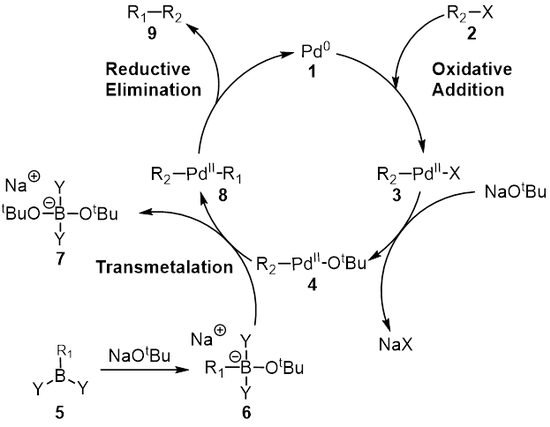
From 1963 until 1965, Suzuki worked as a postdoctoral student with Herbert C. Brown at Purdue University and after returning to the Hokudai he became a full professor there. The postdoctoral experience was utilized in the study of the coupling reaction with his assistant Norio Miyaura and led to the discovery of Suzuki reaction announced in 1979.[7] Its organic boronic acids with aryl and vinyl group are stable to water and air, easy to handle, and because the conditions required for use are also relatively mild, even among the several cross-coupling techniques, it is said to be easy to use.[8] Its full mechanism is shown in the image below.
With his retirement from Hokudai in 1994 he took several positions in other universities: 1994–1995 Okayama University of Science and 1995–2002 Kurashiki University of Science and the Arts.[9] In addition, he was an invited professor at Purdue University (2001), Academic Sinica and the National Taiwan University (2002).
In 2010, Suzuki was jointly awarded the Nobel Prize for Chemistry together with Richard F. Heck and Ei-ichi Negishi.[10]
To celebrate International Year of Chemistry (IYC 2011), Suzuki was interviewed by the UNESCO Courier magazine, he said:
"Today some people see chemistry just as a polluting industry, but that is a mistake......Without it, productivity would drop and we could not enjoy the life we know today. If there is pollution, it is because we are releasing harmful substances. Obviously, we have to adapt treatment and management regimes and work to develop chemical substances and manufacturing processes that respect the environment."[11]
In 2014, a Canadian-Chinese student asked for Suzuki's advice: "how can I become a great chemist like you?", Suzuki answered him: "...above all else, you must learn to see through the appearance to perceive the essence."[12]
Invention without patent
Suzuki has not obtained a patent on Suzuki reaction technology because he thinks that the research was supported by government funds,[13] therefore coupling technology has become widespread, and many products using this technology have been put into practical use.[14] To date, there are more than 6,000 papers and patents related to Suzuki reaction.[6]
Recognition

From left: Suzuki, Negishi, and Heck (2010)

Peter Diamond, Dale T. Mortensen, Christopher A. Pissarides, Konstantin Novoselov, Andre Geim, Akira Suzuki, Ei-ichi Negishi, and Richard Heck, Nobel Prize Laureates 2010, at a press conference at the Royal Swedish Academy of Sciences in Stockholm.
- 1986 – Weissberger-Williams lectureship Award[15]
- 1987 – Korean Chemical Society Award
- 1989 – Chemical Society of Japan Award
- 1995 – DowElanco lectureship Award
- 2000 – The H. C. Brown Lecture Award
- 2003 – Japan Academy Prize
- 2009 – Paul Karrer Gold Medal
- 2009 – Special Member of Royal Society of Chemistry (RSC)
- 2010 – Nobel Prize in Chemistry
- 2010 – Order of Culture
- 2010 – Person of Cultural Merit
- 2011 – Member of the Japan Academy
- 2012 – Honorary Fellowships of RSC[16]
- 2016 – Honorary chair professorship, National Cheng Kung University[17]
See also


- List of Japanese Nobel laureates
References
^ Miyaura, Norio; Yamada, Kinji; Suzuki, Akira (1979). "A new stereospecific cross-coupling by the palladium-catalyzed reaction of 1-alkenylboranes with 1-alkenyl or 1-alkynyl halides". Tetrahedron Letters. 20 (36): 3437–3440. doi:10.1016/S0040-4039(01)95429-2..mw-parser-output cite.citation{font-style:inherit}.mw-parser-output .citation q{quotes:"""""""'""'"}.mw-parser-output .citation .cs1-lock-free a{background:url("//upload.wikimedia.org/wikipedia/commons/thumb/6/65/Lock-green.svg/9px-Lock-green.svg.png")no-repeat;background-position:right .1em center}.mw-parser-output .citation .cs1-lock-limited a,.mw-parser-output .citation .cs1-lock-registration a{background:url("//upload.wikimedia.org/wikipedia/commons/thumb/d/d6/Lock-gray-alt-2.svg/9px-Lock-gray-alt-2.svg.png")no-repeat;background-position:right .1em center}.mw-parser-output .citation .cs1-lock-subscription a{background:url("//upload.wikimedia.org/wikipedia/commons/thumb/a/aa/Lock-red-alt-2.svg/9px-Lock-red-alt-2.svg.png")no-repeat;background-position:right .1em center}.mw-parser-output .cs1-subscription,.mw-parser-output .cs1-registration{color:#555}.mw-parser-output .cs1-subscription span,.mw-parser-output .cs1-registration span{border-bottom:1px dotted;cursor:help}.mw-parser-output .cs1-ws-icon a{background:url("//upload.wikimedia.org/wikipedia/commons/thumb/4/4c/Wikisource-logo.svg/12px-Wikisource-logo.svg.png")no-repeat;background-position:right .1em center}.mw-parser-output code.cs1-code{color:inherit;background:inherit;border:inherit;padding:inherit}.mw-parser-output .cs1-hidden-error{display:none;font-size:100%}.mw-parser-output .cs1-visible-error{font-size:100%}.mw-parser-output .cs1-maint{display:none;color:#33aa33;margin-left:0.3em}.mw-parser-output .cs1-subscription,.mw-parser-output .cs1-registration,.mw-parser-output .cs1-format{font-size:95%}.mw-parser-output .cs1-kern-left,.mw-parser-output .cs1-kern-wl-left{padding-left:0.2em}.mw-parser-output .cs1-kern-right,.mw-parser-output .cs1-kern-wl-right{padding-right:0.2em}
^ Miyaura, N.; Suzuki, A. Chem. Commun. 1979, 866.
^ Suzuki, A. Pure Appl. Chem. 1991, 63, 419–422. (Review)
^ Suzuki, A. J. Organometallic Chem. 1999, 576, 147–168. (Review)
^ 『朝日小学生新聞』2010年10月8日
^ ab 『朝日新聞』2010年10月7日
^ 宮浦憲夫; 萬代忠勝 (2004). "辻二郎先生, 鈴木章先生日本学士院賞を受賞". 有機合成化学協会誌. 有機合成化学協会. 62 (5): 410. doi:10.5059/yukigoseikyokaishi.62.410. 和書.
^ 世界の化学者データベース「鈴木章」
^ Miyaura, Norio; Suzuki, Akira (1995). "Palladium-Catalyzed Cross-Coupling Reactions of Organoboron Compounds". Chemical Reviews. 95 (7): 2457–2483. doi:10.1021/cr00039a007.
^ "The Nobel Prize in Chemistry 2010" (Press release). Royal Swedish Academy of Sciences. 6 October 2010. Retrieved 6 October 2010.
^ http://unesdoc.unesco.org/images/0019/001906/190645e.pdf#nameddest=190724
^ 为什么有些人很聪明?他们遇到问题时的思维方式与我们差别在哪呢? - 知乎
^ 『朝日新聞』2010年10月7日
^ "根岸・鈴木氏、特許取得せず…栄誉の道開く一因". 読売新聞. 2010-10-07. Archived from the original on 2010-10-09. Retrieved 2010-10-08.
^ Akira Suzuki (in Japanese)
^ Japanese Nobel Prize Chemists Honored By Royal Society Of Chemistry | Asian Scientist Magazine | Science, Technology and Medicine News Updates From Asia
^ "Nobel laureate Akira Suzuki receives honorary chair professorship from NCKU - NCKU, 國立成功大學 National Cheng Kung University". Archived from the original on 2017-09-27. Retrieved 2017-09-27.
External links
- Akira Suzuki "Letter to a young chemist" in The UNESCO Courier, "CHEMISTRY AND LIFE", January–March 2011
- The Nobel Prize in Chemistry 2010 Richard F. Heck, Ei-ichi Negishi, Akira Suzuki
- Akira Suzuki
 Japanese Nobel laureates Japanese Nobel laureates | ||
|---|---|---|
| Chemistry |
|  |
| Literature |
| |
| Peace |
| |
| Physics |
| |
| Physiology or Medicine |
| |
Laureates of the Nobel Prize in Chemistry | ||
|---|---|---|
| 1901–1925 |
| |
| 1926–1950 |
| |
| 1951–1975 |
| |
| 1976–2000 |
| |
| 2001–present |
| |
2010 Nobel Prize laureates | ||
|---|---|---|
| Chemistry |
| |
| Literature |
| |
| Peace |
| |
| Physics |
| |
| Physiology or Medicine |
| |
| Economics |
| |
| ||
Authority control  |
|
|---|
Categories:
- Japanese chemists
- Japanese Nobel laureates
- 1930 births
- Living people
- People from Hokkaido
- Nobel laureates in Chemistry
- Recipients of the Order of Culture
- Hokkaido University alumni
- Hokkaido University faculty
- 20th-century chemists
- 21st-century chemists


(RLQ=window.RLQ||[]).push(function(){mw.config.set({"wgPageParseReport":{"limitreport":{"cputime":"0.468","walltime":"0.653","ppvisitednodes":{"value":2364,"limit":1000000},"ppgeneratednodes":{"value":0,"limit":1500000},"postexpandincludesize":{"value":92020,"limit":2097152},"templateargumentsize":{"value":2901,"limit":2097152},"expansiondepth":{"value":12,"limit":40},"expensivefunctioncount":{"value":10,"limit":500},"unstrip-depth":{"value":1,"limit":20},"unstrip-size":{"value":23400,"limit":5000000},"entityaccesscount":{"value":2,"limit":400},"timingprofile":["100.00% 509.077 1 -total"," 29.82% 151.826 1 Template:Reflist"," 27.66% 140.797 1 Template:Infobox_scientist"," 25.74% 131.056 1 Template:Infobox_person"," 21.99% 111.931 3 Template:Cite_journal"," 20.54% 104.567 2 Template:Infobox"," 14.87% 75.706 1 Template:Authority_control"," 10.09% 51.376 3 Template:Navbox"," 6.99% 35.607 1 Template:Nihongo"," 6.29% 32.033 1 Template:Japanese_Nobel_laureates"]},"scribunto":{"limitreport-timeusage":{"value":"0.206","limit":"10.000"},"limitreport-memusage":{"value":5749944,"limit":52428800}},"cachereport":{"origin":"mw1329","timestamp":"20190619142219","ttl":2592000,"transientcontent":false}}});});{"@context":"https://schema.org","@type":"Article","name":"Akira Suzuki (chemist)","url":"https://en.wikipedia.org/wiki/Akira_Suzuki_(chemist)","sameAs":"http://www.wikidata.org/entity/Q105949","mainEntity":"http://www.wikidata.org/entity/Q105949","author":{"@type":"Organization","name":"Contributors to Wikimedia projects"},"publisher":{"@type":"Organization","name":"Wikimedia Foundation, Inc.","logo":{"@type":"ImageObject","url":"https://www.wikimedia.org/static/images/wmf-hor-googpub.png"}},"datePublished":"2010-03-21T05:20:32Z","dateModified":"2019-01-03T14:09:53Z","image":"https://upload.wikimedia.org/wikipedia/commons/c/ca/Nobel_Prize_2010-Press_Conference_KVA-DSC_7383.jpg","headline":"Japanese chemist"}(RLQ=window.RLQ||[]).push(function(){mw.config.set({"wgBackendResponseTime":113,"wgHostname":"mw1269"});});


